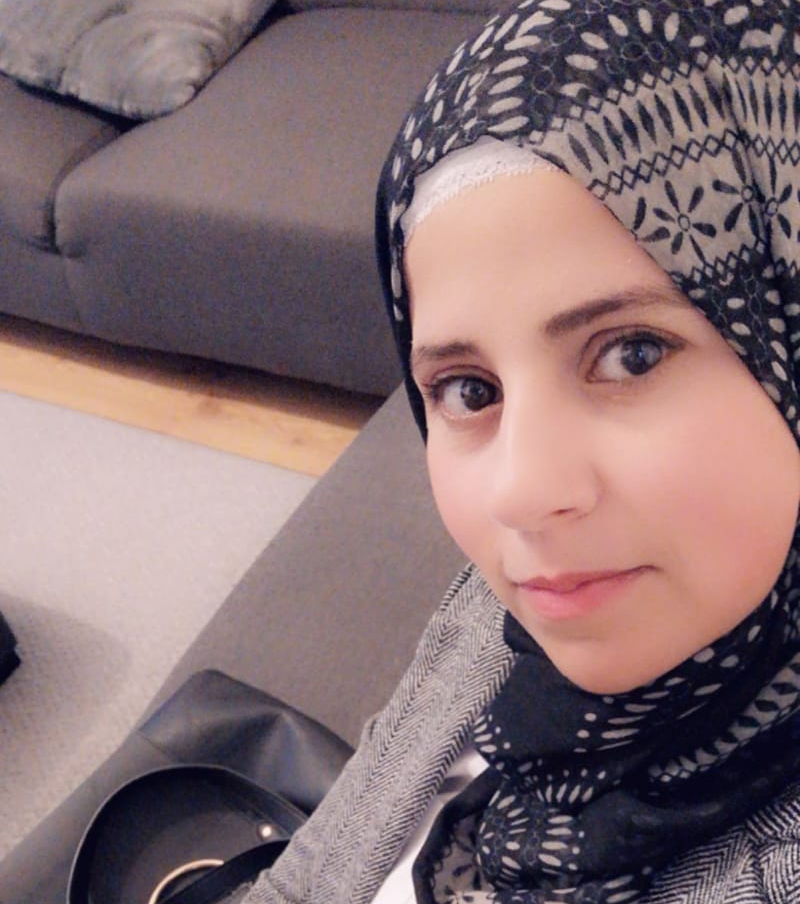
Asmaa is sociable, enterprising, and above all very ambitious. She studied at Damascus University in Syria. Her dream is to work as a laboratory assistant in the Netherlands. She is already well on her way to realizing her dream. We asked her how she is doing this.
You have been living in the Netherlands for 3.5 years now. Can you briefly tell us something about this period?
I came here alone. It wasn't safe enough for my four children to travel here too. I was alone for the first 1.5 years. I live in Beuningen, near Nijmegen. I spoke English very well and I am a sociable person. So I met lots of people. I really enjoy meeting people. This helped me a lot with the language. Now my children and my husband live with me.
You say you've met a lot of people. Where, for example?
At the asylum seekers' center, I met a Spanish woman who is now a good friend of mine. She worked there as a volunteer. She studies and works at Radboud Hospital, and I asked her if I could go with her sometime. I really missed my field of work. She arranged an appointment for me, and I was able to look around the microbiology department. This was truly my best day in the Netherlands! I was able to return to my own life for a moment. I enjoyed being back in the hospital and engaging in my passion.
Is the work as a laboratory technician in the Netherlands and Syria also comparable?
It is similar, but there are also differences. The biggest difference is that in Syria we work a lot with our hands. In the Netherlands, you work much more with machines. The advantage is that you get more precise results, but the disadvantage is that using a lot of machines means you need fewer employees. That's a shame.
You finally arranged an internship at the hospital.
Yes, that's right! Laura, my Spanish friend, and Janneke arranged an initial meeting with the manager. They asked him if I could do some volunteer work. I wanted to stay busy, as my children were still in Syria. I wanted to spend my time usefully. The manager agreed and I was given an 8-month internship contract in the genetics department. This is an international department, so I was able to do everything in English. Within a week, I was able to participate in everything. They had expected it to take a month. They were very surprised. I am also very eager to learn. I really want to know everything. Unfortunately, after the 8 months, I did not get a contract.
What did you go and do?
My family then came to the Netherlands. I passed my B2 level integration exam. Other than that, I didn't have much time to work and study. I was really busy making sure my family could settle here in the Netherlands and that everything was taken care of. After a year, I decided: now they've enjoyed themselves enough, it's time for me to get to work. I applied for my diploma evaluation: MBO4 in laboratory science. This is good enough to work in the Netherlands.
And then I started looking for work...
Yes, that's right! I sent one or two letters every day. Some organizations responded, others didn't. I already had a resume, and during the ONA course (orientation to the Dutch labor market), I learned how to write a letter. I find it difficult to talk about myself. I'm not used to talking about myself and saying what I'm good at.
And you've found a job!
I told the municipality that I really wanted to work. They referred me to the Werkbedrijf, an organization that helps refugees find work. There I met Astrid Peerenboom. She works as a freelancer and supports municipalities and employer service points in helping more people find work. I had a conversation with her and told her what I would like to do. My first job was at Mead Johnson as a laboratory assistant in the microbiology department. This was a six-month contract. Then I was told about the vacancy at Radboud Hospital. Now I work there as a pharmacy assistant. I prepare the medicines. Five hours a day, five days a week. I am no longer receiving benefits.
How did the job interview go?
I really enjoy chatting. And I think Dutch people do too. During the job interview, I immediately started telling them about myself and what it's like in the Netherlands. And they wanted to know more: who is Asmaa?
We also had a lot of fun during the interview. They asked me how I got to work, and I said that I always took the bus. My neighbor always says, "You're not made of sugar, are you?" I mentioned this during my job interview. And now my colleague always says, "Asmaa, are you made of sugar or not?" I still take the bus.
What is your dream job?
My dream is to become a laboratory technician. A month ago, I sent a letter to Laboratorium Clinics in Radboud. They would like to meet me. Last week, I had an interview, and it went well. The downside is that you work in shifts. My husband doesn't do that either. That's why it's not going to work out. Maybe I will continue studying. I attended an open day at Utrecht University of Applied Sciences. Here you can do a part-time 4-year course. I think I can do it faster, because I already completed a degree in Syria. Who knows, maybe I will do this in the future. I do feel like studying.
What tips do you have for newcomers looking for work?
It is important to have a network, learn the language very well, and connect with people. By getting to know people, you can start doing something. Other people can also support you to keep going and make you believe that everything will be okay. Always try to think positively. Stay optimistic. I have no problems with people. I respect everyone, and everyone respects me.
Can you give an example of this?
At Radboud, they actually wear short sleeves as work clothes. I indicated that my religion does not allow me to wear short sleeves. They arranged different clothes for me. I now wear long sleeves. This is not a problem for them. I think that's so nice and kind. This is a really good example of mutual respect. It is important to have a network, learn the language very well, and make contact with people. By getting to know people, you can start doing something.