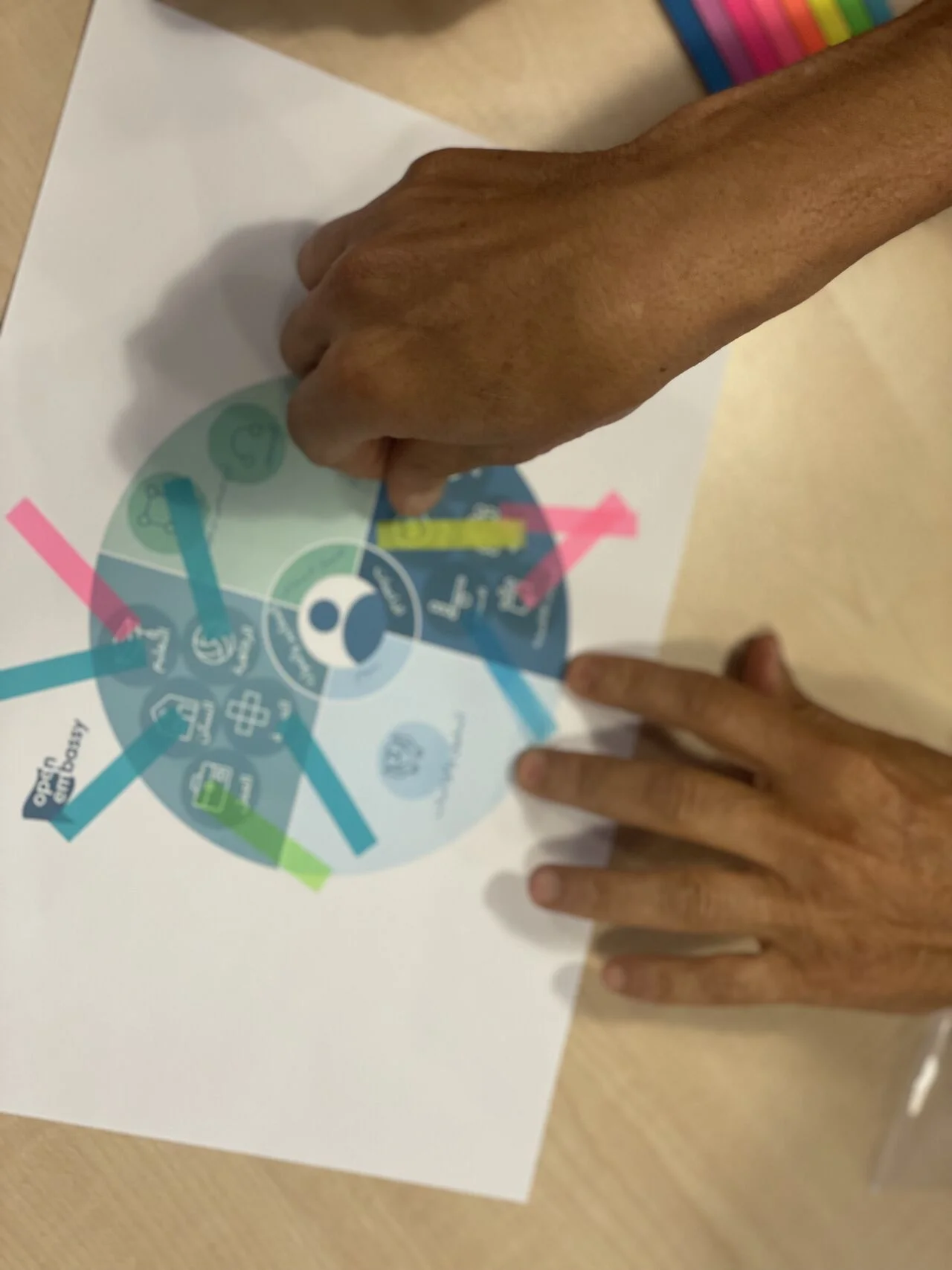
The New Neighbourhood Home is a movement that stands for sustainable and humane solutions for asylum seekers in the Netherlands (asylum and Ukraine reception). This movement includes: the Red Cross, UNHCR Netherlands, VluchtelingenWerk, VNG, WarChild, ARQ, Unicef, Dokters van de Wereld, Save the Children, Untapped Talents, ThuisInOss, Plan Einstein, Migraton Inc, Movement on the Ground, De Toekomstfabriek, Vereniging NOV, Stichting de Vrolijkheid, Pharos, and WelcomeApp. Based on the expertise of each partner, six building blocks have been formed that together constitute the Nieuwe BuurThuis approach: 1. Neighborhood hub: how do we ensure that residents in the shelter leave the shelter and that local residents come to the shelter? 2. Work: how do we match residents to work that suits them and use language/training to achieve this? 3. Peace & Privacy: howdo we ensure that residents experience peace and privacy despite their living situation in the shelter, for example by converting beds and creating quiet rooms? 4. Care hub: how can we provide accessible mental and psychosocial care to residents? 5. Resident participation: how can we increase residents' ownership of the location, for example by listening to their needs, distributing responsibilities, and representation (e.g., through a residents' council)? 6. Safety: how can we increase social safety on site, so that security can eventually be scaled down and replaced by, among other things, the deployment of caretakers, mobile security, and the transfer of tasks to residents?
Together with Utrecht University of Applied Sciences, OpenEmbassy is OpenEmbassy for validating the building blocks on location. The building blocks have been implemented in varying combinations in Utrecht (Ukraine), Bleskensgraaf (asylum), Emmeloord (Ukraine), and Oss (mixed). In the first phase of the research, we will conduct four site visits to gather initial insights into the effectiveness of the building blocks.
Results & insights
The first results at four pilot locations are expected in early 2026.
Related projects
Evaluation pilot AZC Almere
Evaluation study of the pilot of COA, Municipality of Almere and Randstad to guide azc residents to work.
OpenEmbassy and VitaValley are researching the functioning of the Care Café in Venlo. An initiative set up by Dokters van de Wereld to answer care questions of newcomers in a non-medical setting.