Why extra support with schoolwork can be beneficial for newcomer children who are attending the Dutch education system for both long and short periods of time.
What helps children with a refugee background find their place in Dutch education? Through ThuisOnderwijsMaatjes (TOMaatjes), volunteers are paired with children from newcomer families to provide support with schoolwork, language, and integration into the Dutch school system. This study of the TOMaatjes project, conducted by OpenEmbassy the support of the Janivo Foundation, features stories from children, parents, and volunteers. They shared their experiences with the extra guidance offered by TOMaatjes.
By: Hilde Turenhout, Mariana Almeida, Irene del Piazzo, and Josja Sanderink
Research methodology TOMatoes
This study of the TOMaatjes project used action research, supplemented with logbooks, interviews, training sessions, and parent-teacher conferences. The collected data was analyzed thematically using the Indicators of Integration Framework (Ager & Strang, 2008). The emphasis is on four indicators: language, education, building bridges, and safety. According to the internationally recognized model, these are the keys to effective integration. Eight children and seven volunteers participated in this study. Researchers worked closely with volunteers to gain insight into the challenges faced by newcomer children and to contribute directly to solutions. Working methods were continuously experimented with and evaluated jointly.
- Logbooks: After each lesson, volunteers filled out online logbooks with observations, questions, and reflections. These provided insight into learning processes, obstacles, and effective strategies.
- Training and peer review: Volunteers attended three training sessions on NT2, teaching strategies, and peer review. In addition, in-depth meetings and an inspiring interview with an NT2 teacher took place.
- Interviews and parent meetings: Children were interviewed about their school experiences at the beginning and end of the program. Parents shared their perspectives on the home situation, progress, and wishes regarding support.
- School data: Comparison of school recommendations (grades 7 and 8) provided insight into possible developments during the project.
Data-analyse
Data werd gecodeerd en geanalyseerd op thema’s als onderwijs, taal en sociale verbinding. Ethische overwegingen
Er is gewerkt volgens de principes van vrijwillige deelname, anonimiteit en geïnformeerde toestemming. Gegevens zijn zorgvuldig en veilig opgeslagen.
Obstacles
“She also cannot understand assignments because they contain cultural references that she does not understand, such as today's assignment about verbs with ‘Tom Thumb’ as the main character. A child who grew up in the Netherlands understands that reference and knows that it is about a person, but she does not know that.” – Volunteer
- Language barrier: Limited command of Dutch is a fundamental obstacle. Children often do not understand instructions due to a lack of vocabulary and cultural references, which hinders their performance and self-confidence.
- Uneven school performance: Despite aptitude in certain subjects, children face disadvantages, especially in subjects such as math, where language skills are essential. Limited support at home exacerbates this inequality.
- Lack of self-confidence: Repeated failure and language problems make children less willing to contribute in class. This affects their motivation and attitude toward learning.
- Pressure from parents, themselves, and the school system: Children experience high pressure from themselves, their parents, and the school system (such as the transfer test). This pressure leads to fatigue, frustration, and lower performance.
- Social challenges: Many children experience bullying, exclusion, or discrimination, which undermines their sense of security and belonging and negatively affects their learning experience.
Success factors
"She is now proud of herself. I told her so beforehand, but she didn't believe me. However, when she received that advice, she believed she could do it." – Parent
- Language
TOMaatjes offered children customized language support. This gave the children more self-confidence, which was also reflected in their school results. However, language remains an area that requires extra attention for many children, and not every child achieves the level needed to participate fully in class. - Education
Thanks to TOMaatjes, children received targeted help with subjects such as math and language. For many of them, this led to a more positive school recommendation in grade 8 than previously expected. At the same time, it became apparent that the participating children had diverse learning needs, which posed an additional challenge for the volunteers, the tutors. - Home and school
The volunteers played an important role as intermediaries between parents and schools. They helped with parent-teacher conferences, choosing schools, and explaining the Dutch education system. This strengthened parents' confidence, but it remains difficult for families who are new to the Netherlands to fully understand the system and participate in it. - Safety
Children felt seen and heard at TOMaatjes. The calm setting and the involvement of the volunteers contributed to their overall well-being. Some children said they were less afraid of making mistakes and dared to speak up more in class. However, social safety at school, such as bullying and exclusion, remained a problem for some that the TOMaatjes volunteers alone could not solve.
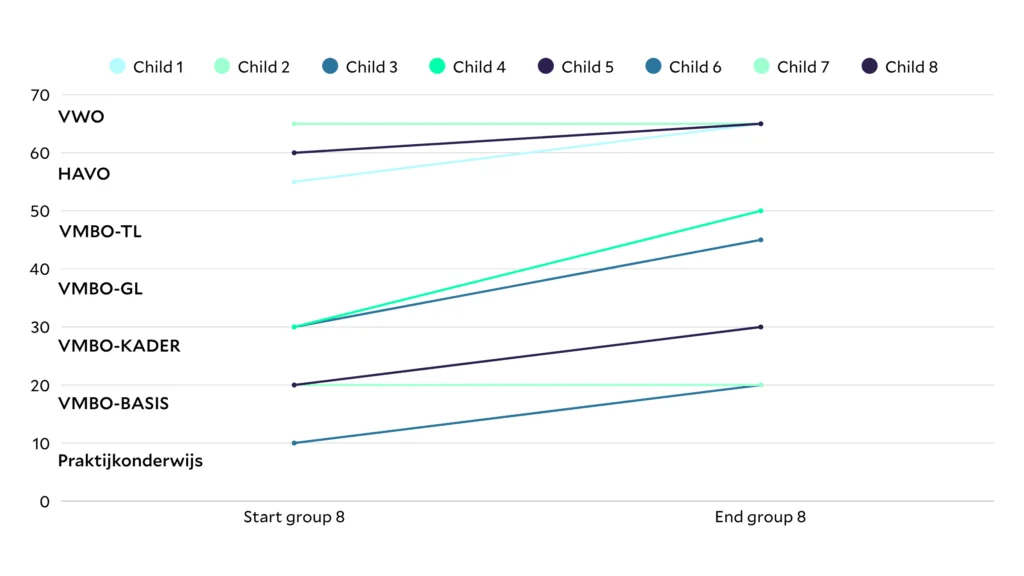
Tabel 1. Schooladvies aan het begin van groep 8 en het definitieve advies aan het eind van groep 8.
In conclusion
The results are encouraging, but structurally, more is needed than after-school support from volunteers.
In this study, TOMaatjes volunteers demonstrated how important individual attention, involvement, and trust are for newcomer children. The results are encouraging: more enjoyment at school and improved language skills. At the same time, it is clear that structural extra attention for these children, by schools and municipalities, remains necessary. Because the challenges cannot be solved with just a few hours a week. TOMaatjes works, but only as part of a larger whole.

“Ze is nu trots op zichzelf. Ik zeg het van tevoren, maar ze geloofde me niet. Maar toen ze dat advies kreeg, geloofde ze dat ze het kon.”
Milestone research TOMatoes
More about the research
Additional support
More on the project

Questions or reactions?
Please contact Josja