
How can we ensure that newcomers can truly participate in society?
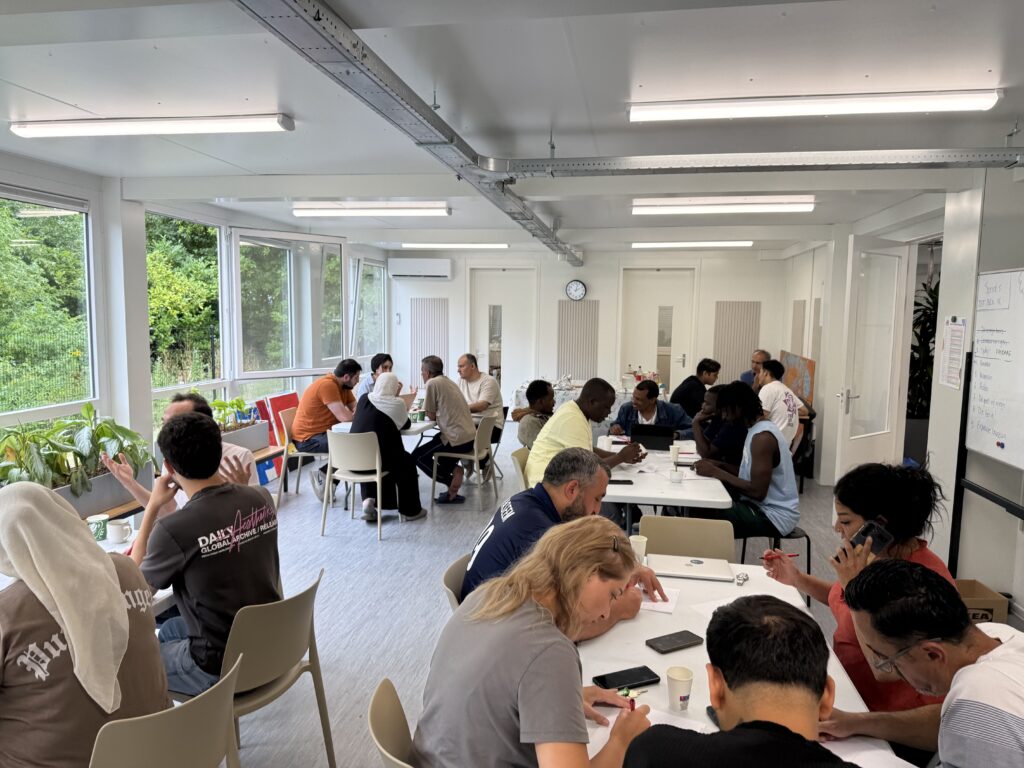
Not just through guidance or rules imposed from above, but by working with them to develop approaches that work. This has been put into practice in the pilot project for Social Service Time (MDT) and the Participation Desk: a participatory approach in which newcomers were able to actively contribute their ideas. The results are not only inspiring, but also useful for anyone working on integration, participation, or youth policy. The full report can be found at the end of this article.
What exactly is MDT?
MDT is an initiative of the Ministry of Education, Culture and Science (OCW), in collaboration with the Integration Policy Department of the Ministry of Social Affairs and Employment (SZW). The aim is to support young people in their participation in society. In the Meedoen pilot project, OCW and SZW have joined forces to reach a broader target group of newcomers. Within the project, we specifically researched the target group of young newcomers living in asylum seekers' centers (azc).
The MDT program involves this group in activities that are good for themselves and for others: they learn the language, meet people, and feel at home more quickly. So, MDT offers them opportunities for personal and professional development and acts as a bridge to a new life in the Netherlands. This strengthens social cohesion in society.

“I have met so many people, and my network has grown enormously. People are now helping me with my plans for the future.” - participant
Investigate how MDT contributes
To achieve this goal, pilot projects were launched at various asylum seekers' centers, which OpenEmbassy monitored and evaluated by OpenEmbassy . We focused primarily on how well the MDT program meets the needs of young newcomers and where there is room for improvement. We investigated how MDT contributes to their integration and how the collaboration with the Meedoenbalies (Participation Desks) in the Netherlands is going. We also looked at the experiences and insights of the employees involved to find out what is needed to make the program more effective.
The final report presents the initial findings. It provides a clear picture of how the MDT program currently works. Based on these findings, we also make suggestions for further improving the program.
Key insights
- Meaning is crucial: Many newcomers experience participation as more than just work or education. Meaning, belonging, and feeling useful are central. MDT proved to be a powerful route to achieve this.
- Language is not a prerequisite, but a consequence: By actively participating in volunteer work and engaging in conversation with others, language skills improved naturally. Participants indicated that it was precisely their participation that accelerated their language development.
- Trust and closeness are indispensable: The role of committed counselors and contact persons (often with a migration background themselves) proved to be essential. They offered security and understanding, which made participation accessible.
- Room for customization works: Instead of a fixed program, participants were able to design their MDT program in a way that suited them. This flexibility made participation accessible and effective.
“I feel useful. I see the impact of what I do, and that makes me happy.” - participant
Recommendations
At present, MDT faces several challenges, particularly with regard to limited visibility and accessibility. There is also room for improvement in terms of the formal recognition of MDT and career opportunities after completion. However, these challenges also present opportunities. Various recommendations have been drawn up based on these challenges. The most important ones are listed below:
- Improve recruitment strategies:
Actively promote MDT within asylum seekers' centers and work more closely with COA staff. Engaging former participants as ambassadors and organizing accessible introductory activities also helps to encourage new participants.
- Simplify administration:
Simplify the registration process to make participation more accessible, and provide clear introductory sessions on the possibilities within MDT.
- Ensure formal recognition and certification:
Let MDT experiences count towards integration programs. Recognition by municipalities and the IND increases young people's motivation to participate.
- Strengthen sustainable cooperation and coordination:
Provide more permanent supervisors per location and offer personalized guidance to ensure continuity and remove barriers such as language barriers and uncertainty.
- Improve transfer opportunities after MDT:
Strengthen the link between MDT and work, education, and volunteer work. Encourage long-term involvement for young people who want to continue their MDT project.
- MDT should be implemented nationwide:
There are calls to set up MDT as a single national organization, active in all asylum seekers' centers in the Netherlands. This would increase the impact of the program and ensure that all newcomers have access to the opportunities offered by MDT.
- MDT as a means for mental well-being and social stability:
MDT offers structure and stability for young people who feel uncertain about their future and could therefore be explicitly positioned as a welfare program.
By implementing these improvements, MDT can play a greater role in the integration and participation of young newcomers in Dutch society.
Want to know more?
Do you work with young people, newcomers, or on inclusion in a broader sense? Then this report not only offers insights, but also practical tools. It shows how to truly engage people, how to provide space for meaning, and how to set up processes based on trust and equality.
Download report
"Analysis of the effectiveness of MDT and Meedoenbalie programs"