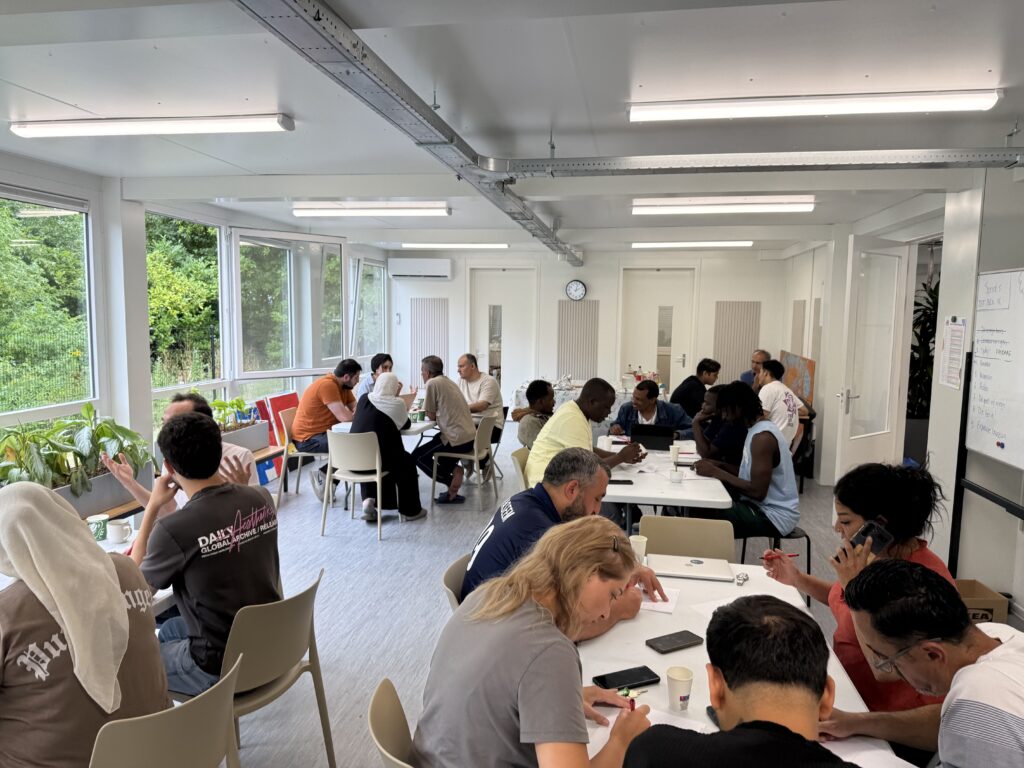

On February 20, OpenEmbassy, Regioplan, and BMC organized the Online Knowledge Session on the Perspective of Newcomers. Policymakers, researchers, and practitioners discussed the findings of the second report of the Integration Perspective study. This large-scale study, commissioned by the Ministry of Social Affairs and Employment, offers valuable insights into how integration participants experience the system. The session focused on four themes: Customization, Information Provision, Duality, and Family Migrants. In this article, we will take a closer look at the second theme: information provision in integration.
Information provision is fundamental to participation
Good information provision forms the basis for successful integration. If newcomers do not know where they stand, what their rights and obligations are, and what is expected of them, they will not get off to a good start. The research and knowledge session made it clear that many newcomers lack crucial information, which has a direct impact on their chances of success.
What is information provision in integration? This is all communication directed at integration participants about their:
- Route
- Rights and obligations
- Facilities
- Options and choices
This starts upon arrival in the Netherlands and continues throughout the entire integration process. Various parties play a role in this: municipalities, DUO, COA, language schools, and social organizations.
Good information is understandable, timely, repeatable, and available in the language of the immigrant. It helps them to make independent choices and build their lives in the Netherlands. Providing information during the integration process is therefore not just a side issue, but a foundation for participation.
How do newcomers experience the provision of information?
In practice, we see a mixed picture. Some municipalities manage to provide clear, timely information. Newcomers appreciate it when they are approached personally, when interpreters are present, or when a designated contact person answers their questions. Personal guidance in particular appears to be an important factor for success.
Nevertheless, the study shows that information in the integration process arrives too late, is too complicated, or is not provided at all. There are differences between municipalities in what is communicated and how. This can lead to confusion, uncertainty, or missed opportunities.
What's going well
Dedicated contacts and client managers are valued
Integration program participants who have a dedicated client manager see them as the key to clear information. The relationship is crucial: if there is room for personal attention and empathy, the information is perceived as much more useful.
Access to information in one's own language aids comprehension.
When interpreters are available or information is available in the native language, this helps to ensure that information is better understood.
Information meetings and visual support
Municipalities that use meetings or visual aids (such as pictograms or videos) make complex topics easier to understand.
Quick start when the asylum seekers' center and the municipality coincide
When people stay in an asylum seekers' center in the same municipality where they will be integrating, the transfer of information runs more smoothly and the process starts more quickly.
Language buddies and informal networks as additional resources
Newcomers who have access to language buddies or communities often experience better information provision because peers share practical tips.

“My contact person explains everything clearly and is really the key to getting the right information for me.” - research participant
Bottlenecks
- Information does not arrive at the right time, is too difficult, or is incomplete.
- Newcomers receive conflicting information from different parties.
- There are differences between municipalities in terms of what is communicated and how.
- Digital information is often difficult to access due to language level, limited digital skills, or lack of equipment.
- Important topics such as work, income, taxes, and continuing education remain underexposed.
"Some newcomers receive information too early, which means they don't find it relevant yet. Or too late, which means they miss out on opportunities." - webinar participant
How information provision in integration can be improved
During the knowledge session, various possible solutions emerged for improving the provision of information in the integration process:
Repeat information at multiple times and in multiple ways
Not all information is absorbed immediately, especially in a new language and new environment.
Use understandable language and visual aids
Visual aids help people to better understand complex rules. Use a discussion board, for example.
Ensure good timing
Provide information during the integration process when someone needs it, not just at the start of the process.
Invest in personal contact
A designated contact person makes all the difference in terms of trust and clarity.
Tailored information
Provide targeted, tailored information depending on the learning pathway and personal circumstances. This includes important basic information about housing, studying, healthcare, and finances.
Extra guidance for family migrants
Provide extra guidance to family migrants, who often do not receive the same support and are responsible for their own pathway.
"Students attend the Start-up Class for eight weeks before beginning their integration program. At each session, we review the content of the previous discussion and check whether there are any questions about what was discussed." - webinar participant
What can we learn from this?
Clear, accessible, and timely information provision is an essential prerequisite for effective integration. Without good information, newcomers cannot take control of their integration process and become dependent on others. This not only hinders their self-reliance, but also frustrates the goal of the Integration Act: participation and integration.
Policymakers, municipalities, and professionals can make a difference in this regard. By taking the provision of information in the integration process as seriously as language education and participation, and by focusing on accessibility, timing, and repetition. By listening to the experiences of those undergoing integration and responding to them, we can work together to build an inclusive and understandable integration process.
Online Knowledge Session
How can we ensure that integration program participants receive accurate information? In the Online Knowledge Session, we discuss specific cases and recommendations from the study.