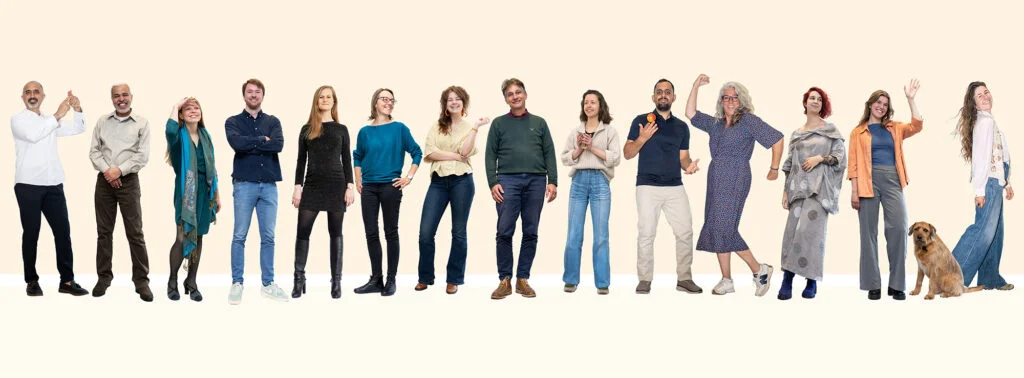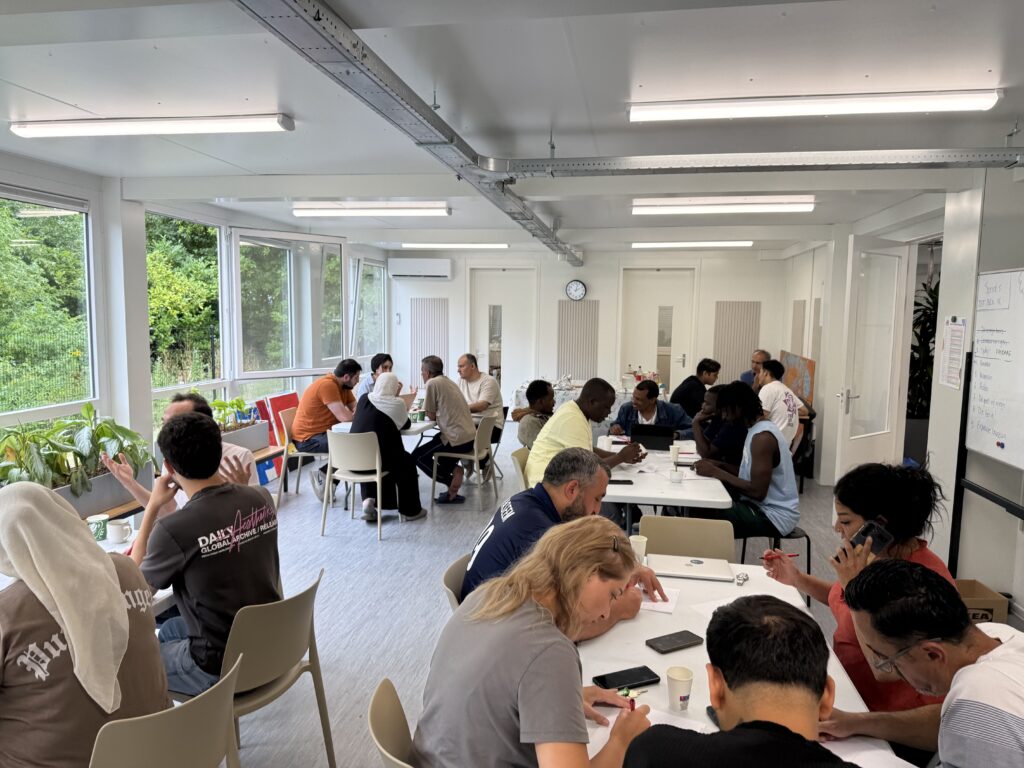
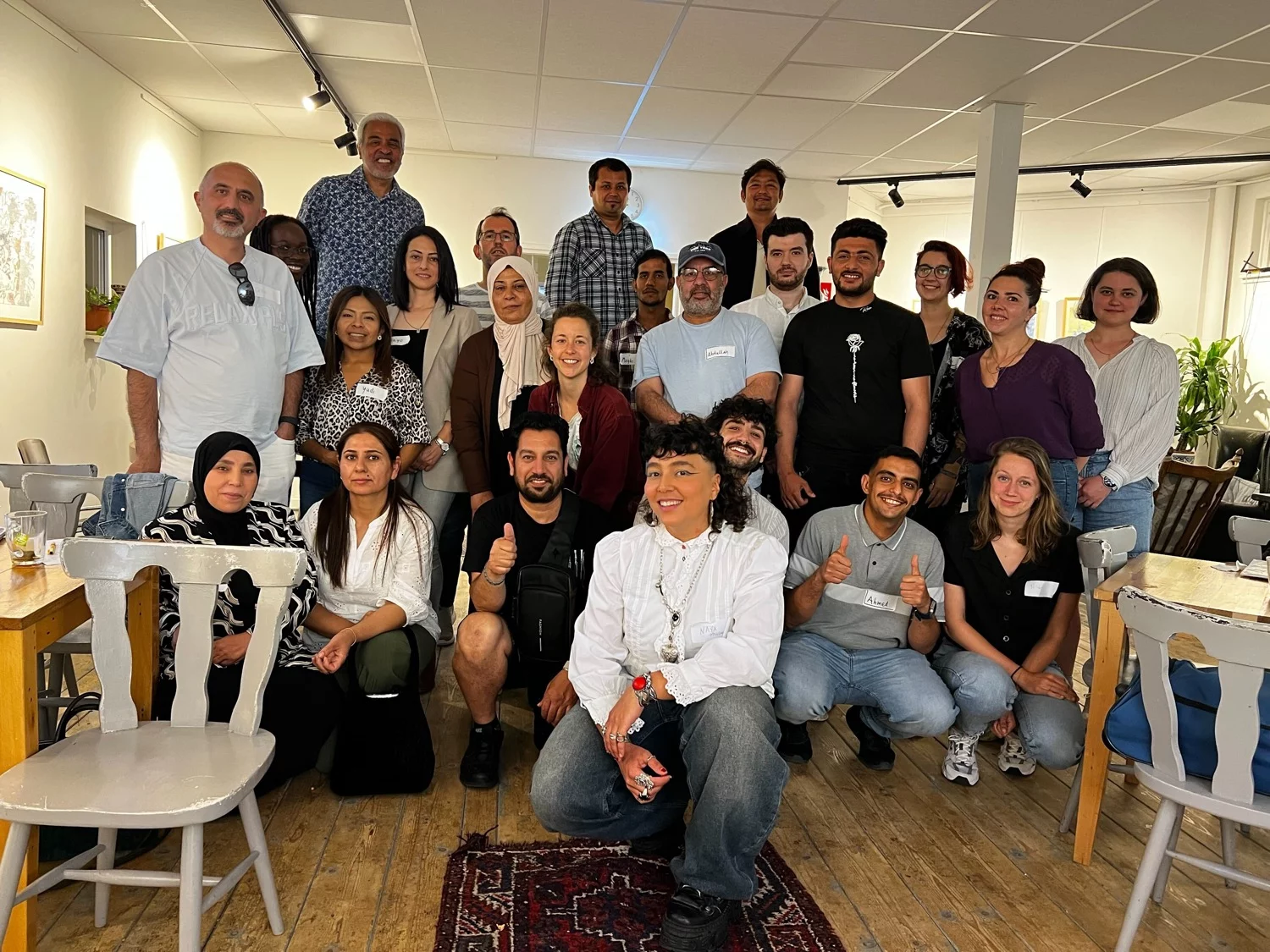
The core of OpenEmbassy methodology OpenEmbassy that we place the experience of newcomers at the center of our research. This applies both to our research goal—learning from the experience of newcomers in order to develop evidence-based integration policy—and to our team. We strive to involve researchers with migration experience in every project, in a variety of roles: from recruiting participants and facilitating expert groups to data analysis. The input of newcomers within our team contributes greatly to the quality of our research.
By: Ani Popova
Building trust and overcoming barriers in research
Researchers who work with participants from marginalized communities, such as many newcomers, often work with people who have experienced the worst of a system, for example in their country of origin. Position theory teaches us that social and political experiences inevitably shape individuals' perspectives (Harding, 2018). One aspect of being marginalized is that your perspective is systematically not heard or taken into account in decision-making.
If expressing your opinion is regularly rejected or even punished, a self-defense mechanism develops to prevent you from being overwhelmed by future consequences and to avoid them altogether. You may then distrust anyone who claims to want to listen to you. The more tension you have experienced with a system and its representatives, the more defensive and cautious you become in what you share, especially with people you see as representatives of that system (Foucault, 2019).
Working sensitively with marginalized communities
It is important to be aware of this in order to understand the sensitivity involved in working with marginalized communities. At OpenEmbassy , we regularly OpenEmbassy this when conducting research with communities of newcomers to Dutch society. We have developed several methods, such as: action research with newcomers, difference-sensitive surveys, and expert pools. These are group sessions in which participants are positioned as experts in the field of their own experiences, challenges, and needs.
In all approaches, we see how important it is to make participants feel safe so that they can share their experiences. Our work regularly shows that involving researchers with experiential knowledge in the research process helps to reduce power differences between our team and the participants. This also helps to build a collaborative relationship with participants, as it becomes clearer to them that our goal is to amplify their voices and work together.

"In all approaches, we see how important it is to make participants feel safe so that they can share their experiences."
Experiential knowledge in recruitment encourages participants to join in
The first contact with participants is crucial. When recruiting potential participants for various research projects, the most important goal is to show them that the project is a place where they will feel safe and heard, and where their voice is genuinely valued.
It is much easier for people to believe this when they are approached by someone who shares some of their experiences. These similarities do not always have to include the same country of origin or the same culture. Sometimes it is enough to meet someone who, like themselves, speaks Dutch with an accent as a second (or third or fourth) language. Or who, like them, is a young mother who works.
Experiential knowledge in coaching builds trust
During the research itself, the experiential knowledge of a facilitator is even more valuable. This is especially true when facilitating expert pools (or any other group-oriented research approach). The facilitator can more easily build rapport with participants and break down barriers that stand in the way of trust. It is easier to connect and show compassion when you can draw on your own experiential knowledge, and it is also much easier for participants to accept that the compassion they receive is genuine. Through experiential knowledge, facilitators can also more easily sense what problems participants may have and come up with solutions on the spot.
Advantages of comparable positionality
Researchers have identified significant advantages to having a similar positionality to the research participants. First, participants are more willing to share their experiences with researchers whom they perceive as sympathetic to their situation, which gives researchers easier access to the field (De Tona, 2006).
Secondly, the nature of the relationship between researcher and participant is always influenced by the socioeconomic identities of both parties, which affects the information participants are willing to share. People often feel more comfortable sharing vulnerable experiences related to their socioeconomic identity with researchers who share the same identity—for example, a woman with another woman or an immigrant with another immigrant (Kacen and Chaitin, 2006; Berger, 2015).
"Researchers with experiential knowledge have an advantage in knowing the subject and understanding nuanced responses from participants."
In addition, researchers with experiential knowledge have "an advantage in knowing the subject and understanding nuanced responses from participants" (Berger, 2015, p. 223). This provides a "cultural intuition" about the research, which helps researchers raise topics more easily (or even recognize that they need to do so).
It also enables researchers to better recognize implied content and important sensitivities—a crucial resource for knowing what to ask and how to ask it, and for understanding answers in a nuanced way (Berger, 2015).
Limitations of empirical research
With the historical development of qualitative methods and social sciences, a clear understanding has emerged that there is no single way to understand the world. And that there is no ultimate truth that can be discovered through empirical measurement (Denzin & Lincoln, 2008). Social reality is socially constructed, and all data is always produced within a specific context.
It is shaped by the perspectives and interpretations of participants, but also those of the researcher. Every person has their own biases and subjective perspectives, and all knowledge is constructed within the context of the people who construct it.
A diverse team delivers better data analysis
At OpenEmbassy , we OpenEmbassy to put data and knowledge at the forefront of policymaking in the most objective way possible. Our approach to data collection focuses on recording the experiences of newcomers in a factual and honest manner. We want to give policymakers the insights they need to develop effective policies based on the reality of those affected by them.
However, we recognize that complete objectivity in social research is difficult, if not impossible, to achieve. Data analysis and interpretation are always influenced by the context of the research and by the background and insights of the researchers. Methodologically careful choices, critical self-reflection, and a diverse team that helps minimize blind spots are ingredients for dealing with this consciously and carefully.
Personal reflexivity
An important part of conducting research is reflexivity: recognizing where your own biases lie as a person, so that you can separate them from the research. It is especially important to recognize that the more a person fits within a dominant vision, the easier it is to miss their own biases. This happens because there is less conflict with the outside world and less challenge to their own way of thinking and biased ideas and assumptions about the world (Harding, 2018).
Simply put, the more someone belongs to a majority group (for example, a person born in the Netherlands who lives in the Netherlands), the easier it is to miss their own biases. That is why it is crucial to work in diverse teams, especially with people who have similar experiences to the research participants. Diversity of perspectives is one of the best ways to check and resolve each other's biases.
Personal reflexivity is one of the benchmarks for ensuring the quality of any research project. When this occurs within a team, where team members can support each other, it is reinforced by others who highlight our individual blind spots (Russell & Kelly, 2002; Horsburgh, 2003).
An invitation to an inclusive approach to research
Our approach at OpenEmbassy that research is not just about collecting data, but about truly understanding and capturing human experiences. By working with researchers who bring experiential expertise to the table, we offer insights that help policymakers make informed decisions. It enables us to capture a wealth of perspectives that benefit policy-making. We invite everyone to embrace this approach to research and thus contribute to a world in which policy is truly tailored to the experiences of those it affects.
Bibliography
- Berger, R. (2015). Now I see it, now I don’t: Researcher’s position and reflexivity in qualitative research. Qualitative research, 15(2), 219-234.
- Denzin, N. K., & Lincoln, Y. S. (2008). Introduction: The discipline and practice of qualitative research.
- De Tona, C. (2006). But what is interesting is the story of why and how migration happened. In Forum Qualitative Sozialforschung/Forum: Qualitative Social Research, 7(3).
- Foucault, M. (2019). Power: the essential works of Michel Foucault 1954-1984. Penguin UK.
- Harding, N. (2018). Feminist methodologies. The SAGE handbook of qualitative business and management research. London: Sage, 138–152.
- Horsburgh, D. (2003). Evaluation of qualitative research. Journal of Clinical Nursing (Wiley-Blackwell), 12(2).
- Kacen, L., & Chaitin, J. (2006). "The times they are a changing": Undertaking qualitative research in ambiguous, conflictual, and changing contexts. The Qualitative Report, 11(2), 209-228.
- Russell, G. M., & Kelly, N. H. (2002). Research as interacting dialogic processes: Implications for reflexivity. In Forum qualitative social research/forum: Qualitative social research 3(3).